Dubai has solidified its status as the premier medical tourism and private healthcare capital of the Middle East, driven by mandatory health insurance laws, accelerated population influx, and forward-thinking regulatory modernization by the Dubai Health Authority (DHA). For foreign medical groups, sovereign healthcare funds, and specialist medical entrepreneurs, establishing an outpatient clinical facility in Dubai mainland represents an exceptionally lucrative venture. However, medical licensing in Dubai is distinct from conventional commercial company formation: it involves a stringent, synchronized dual-track workflow spanning commercial licensing through the Department of Economy and Tourism (DET) and clinical facility certification through the DHA Sheryan portal. This guide details every legal, spatial, clinical, and financial benchmark required to navigate the process smoothly in 2026.
1. Executive Summary & Market Landscape
Capitalising on Dubai’s AED 18+ Billion Outpatient Healthcare Sector
Dubai’s private healthcare ecosystem has experienced unprecedented structural expansion over the past decade. Bolstered by Federal Law No. 4 of 2015 concerning Private Health Facilities, Dubai Law No. 32 of 2015, and the UAE Mandatory Health Insurance Scheme (ISAHD), over 92% of all outpatient clinical interactions in the emirate take place within privately owned and operated health facilities.
In 2026, foreign direct investment into private clinics, specialized polyclinics, aesthetic dermatology centers, and ambulatory day surgery suites has reached unprecedented levels. High-net-worth demographic migration, regional medical tourism corridors spanning the GCC, Africa, and Central Asia, and tax-efficient corporate frameworks combine to generate industry-leading internal rates of return (IRR) for clinical operators.
Nevertheless, healthcare represents one of the most rigorously supervised sectors in the UAE economy. Capital allocation errors during physical site selection, spatial layout misinterpretations under DHA Health Facility Guidelines (HFG), or delays in medical staff Primary Source Verification (PSV) can delay clinic opening timelines by months, depleting startup reserves. Achieving rapid regulatory clearance demands a rigorous, sequence-driven execution model.
All private health institutions operating within the Emirate of Dubai must comply with the unified DHA Health Facility Guidelines (HFG 2026 Part B – Clinical Planning Units). Failure to secure prior architectural approval from the DHA Health Regulation Sector before commencing physical fit-out invalidates municipal fit-out permits and incurs punitive administrative sanctions.
2. 100% Foreign Ownership & Sovereign Legal Framework
Full Equity Autonomy Without Local Sponsorship Requirements
Historically, foreign clinical practitioners and healthcare investors seeking mainland commercial registration in Dubai were compelled to operate under professional license structures requiring an Emirati National Service Agent (LSA), or commercial limited liability companies with a 51% local equity proxy. This historical friction was decisively abolished by UAE Federal Decree-Law No. 32 of 2021 on Commercial Companies and the comprehensive liberalization of foreign direct investment by the Dubai Department of Economy and Tourism (DET).
Today, international doctors, hospital chains, and foreign corporate holding entities are entitled to 100% legal equity ownership in clinical medical facilities registered across Dubai mainland. The corporate entity is structured as a private Limited Liability Company (LLC) or a Branch of a Foreign Company. Shareholders enjoy absolute dividend repatriation rights, direct board appointment prerogatives, and unfettered ownership of clinical intellectual property and pharmaceutical inventory.
Crucially, UAE statutory corporate law decouples financial ownership from professional medical credentialing. A foreign investor, family office, or venture fund does not need to hold clinical qualifications to establish, own, and profit from a licensed clinic. However, administrative sovereignty over clinical diagnosis, prescribing protocols, and patient safety remains strictly vested in a certified Medical Director registered with the Dubai Health Authority.
While the Department of Economy and Tourism (DET) issues your commercial legal personality and trade register (Commercial License), the clinic cannot attend to a single patient or import prescription medical supplies until the Dubai Health Authority issues the final Facility Operating Permit (DHA Health Facility License).
3. Dual-Track Architecture: DET vs. DHA Sheryan
Synchronizing Commercial Company Formation with Clinical Health Certification
The central operational challenge in establishing a Dubai medical clinic lies in managing two parallel regulatory bodies whose processes interlock at predetermined milestones: the Department of Economy and Tourism (DET) for corporate formation, and the Dubai Health Authority (DHA) via its digital Sheryan e-licensing infrastructure for healthcare certification.
An error frequently committed by inexperienced consultants is attempting a linear sequence—completing all DET commercial steps before engaging the DHA, or conversely signing an expensive long-term lease before securing preliminary DHA architectural acceptance. In reality, modern establishment requires a synchronized dual-track workflow where corporate naming, tenancy negotiation, structural engineering approvals, and physician credentialing advance in tandem.
The following comparative architecture outlines the respective jurisdictions and responsibilities of the DET Commercial Track versus the DHA Health Regulation Track throughout the setup journey:
| Regulatory Dimension | Department of Economy & Tourism (DET) | Dubai Health Authority (DHA) | Dubai Civil Defence & Municipality |
|---|---|---|---|
| Primary Domain | Commercial legal personality, Trade Register & Corporate Structure | Clinical compliance, Healthcare facility standards & Medical safety | Building code, MEP safety, Fire protection & Environmental hygiene |
| Key Deliverables | Trade Name Reservation, Initial Approval, MoA, Commercial License | Layout Approval, Medical Director Approval, Final Facility License | Building Fit-out Permit, Civil Defence Fire Safety Clearance, NOC |
| Digital Portal | Invest in Dubai / DET Commercial Register Portal | DHA Sheryan Health Regulation Platform | Dubai Building Permit System (BPS) & DCD Portal |
| Key Milestones | Legal corporate establishment & corporate bank account eligibility | Clinical architectural clearance, staff credentialing & on-site audit | Structural fit-out completion & life-safety operational clearance |
| Average Timeline | 3 to 7 business days for commercial foundation | 60 to 75 business days spanning fit-out and audits | 20 to 30 business days during construction phase |
4. Clinic Facility Classifications & Spatial Standards
Defining Your Scope: General Clinic, Polyclinic, or Ambulatory Day Surgery Center
The Dubai Health Authority classifies outpatient medical facilities into explicit tiers based on clinical complexity, surgical invasiveness, and diagnostic infrastructure. Investors must accurately select their target classification at inception, as each tier enforces distinct architectural, spatial, clinical staffing, and equipment parameters that cannot be retroactively altered without extensive structural modifications.
General Clinic: Tailored for single-practitioner practices or solo medical disciplines (e.g., General Practice, Psychiatry, or solo Nutrition). A General Clinic requires a compact footprint (typically 450 to 650 sq ft) comprising a dedicated consultation room, an examination area, a clean utility cabinet, a dirty utility room, patient waiting areas, and a DDA-compliant restroom.
Polyclinic: The most prevalent investment vehicle in the UAE private sector. A Polyclinic must accommodate two or more distinct medical specialties (such as Internal Medicine, Dermatology, Cardiology, or Obstetrics & Gynecology). Minimum spatial requirements scale to 1,200–2,500 sq ft, necessitating a dedicated Resuscitation & Triage room, separate clean and dirty utility rooms, a centralized sterile services department (CSSD) or validated autoclave station, and specialized biomedical waste refrigeration lockers.
Day Surgery Center (Ambulatory Surgical Facility): Designed for invasive surgical, diagnostic, and aesthetic procedures performed under general, spinal, or conscious sedation without overnight patient hospitalization. These facilities demand substantial capital investment (5,000 to 15,000+ sq ft) and must incorporate Class A/B/C operating theatres, certified HEPA positive-pressure laminar air flow, dedicated pre-operative holding bays, post-anesthesia care units (PACU), backup generators, and medical gas pipeline systems (O2, N2O, Vacuum).
| Facility Classification | Minimum Area (Sq Ft) | Required Specialties | Surgical Capability | Specialist Mechanical Standards |
|---|---|---|---|---|
| General Clinic | 450 – 650 sq ft | 1 Medical Discipline | Minor dressings & non-invasive triage | Standard split/central HVAC, acoustic insulation STC 45 |
| Polyclinic | 1,200 – 2,500 sq ft | Minimum 2 Distinct Specialties | Minor outpatient procedures (local anesthesia only) | Dedicated clean/dirty utility separation, Resuscitation Room |
| Specialty Dental Center | 800 – 1,800 sq ft | Dental / Orthodontic / Oral Surgery | Oral surgery with conscious sedation capability | Lead-shielded OPG/CBCT room (2mm Pb), dedicated suction plants |
| Day Surgery Center (DSC) | 5,000 – 15,000+ sq ft | Surgical & Anesthetic Specialties | Elective surgeries under General / Regional Anesthesia | ISO Class 5/7 Operating Suites, HEPA filtration, PACU bays, Medical Gas |
5. The 5-Phase Licensing Roadmap & Milestones
A Chronological 90-Day Step-by-Step Blueprint to Official Operation
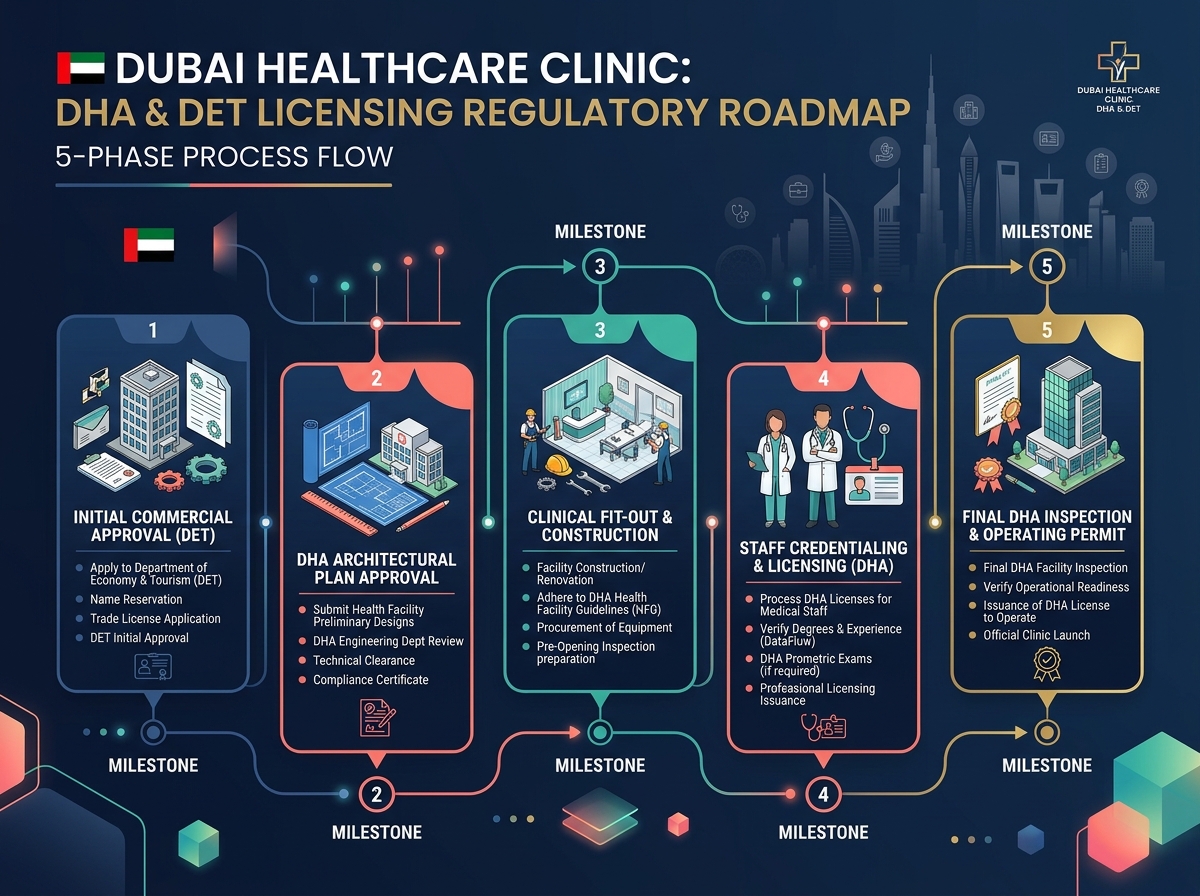
Successfully navigating the regulatory corridor requires adherence to a five-phase critical path. Each phase carries specific dependencies: commercial approvals unlock architectural filings, which enable physical construction, leading to clinical credentialing and culminating in sovereign audits.
Phase 1: Corporate Foundation & Initial Approvals (Days 1–10). The investor submits a proposed commercial trade name complying with DET and DHA naming conventions (which prohibits misleading medical terms or superlatives). DET issues the Initial Approval and registered Trade Name Certificate. The Memorandum of Association (MoA) is executed electronically, establishing the 100% foreign-owned LLC.
Phase 2: Premise Sourcing, Ejari Registration & DHA Architectural Layout Review (Days 11–30). The investor identifies suitable commercial real estate. Before signing a binding multi-year commercial lease, the floor plans are vetted against DHA guidelines. An Ejari (registered tenancy contract) is secured. A DHA-approved architectural engineering consultant prepares detailed 2D architectural layouts, plumbing schematics, and clinical room schedules, submitting them through the DHA Sheryan portal for Preliminary Facility Approval.
Phase 3: Physical Fit-out, Engineering Execution & Civil Defence Audit (Days 31–70). Upon receiving the DHA Initial Layout Approval, municipal fit-out permits are obtained through Dubai Municipality and Dubai Civil Defence (DCD). Certified MEP contractors execute room partitioning, specialized acoustic drywalling, medical-grade antibacterial flooring, HVAC ventilation balancing, and fire suppression systems. Upon completion, DCD conducts an on-site life-safety inspection to grant the Civil Defence Fire Safety Certificate.
Phase 4: Medical Staff Credentialing & Medical Director Registration (Days 45–80). Concurrently with the physical build, recruitment of the medical workforce commences. Every practicing doctor, specialist, and registered nurse must undergo Primary Source Verification (PSV) via DataFlow and hold active DHA professional eligibility letters or licenses. The clinic formally assigns its licensed Medical Director in the Sheryan portal.
Phase 5: Final DHA Physical Inspection & Operational Permit Activation (Days 81–90). With fit-out finalized, medical equipment calibrated, biomedical waste contracts registered with Dubai Municipality, and staff rosters populated in Sheryan, the clinic requests the Final DHA Facility Audit. DHA Health Regulation inspectors conduct an exhaustive on-site audit of clinical rooms, sterilisation suites, emergency medications, patient record management software (EMR), and infection control policies. Upon successful audit sign-off, the official DHA Health Facility License is issued, enabling patient intake.
Do not wait for physical clinic fit-out completion before initiating physician and nurse credentialing. Primary Source Verification (PSV) via DataFlow routinely takes 20 to 30 working days for international medical degrees. Run professional credentialing concurrently with Phase 3 construction to avoid having a completed facility sit idle awaiting staff clearance.
6. DHA Health Facility Guidelines (HFG 2026) & MEP Specs
Technical Standards for Ceilings, HVAC, Infection Control & Accessibility
The Dubai Health Authority enforces one of the most comprehensive architectural and spatial health codes globally. Standard commercial office fit-outs are thoroughly non-compliant for clinical applications. Architectural consultants and MEP (Mechanical, Electrical, and Plumbing) contractors must strictly design to the DHA Health Facility Guidelines (HFG 2026 Edition).
Finishes & Infection Prevention: All clinical flooring must be seamless, non-porous, slip-resistant, and coved at least 150mm up the wall perimeter with chemical-welded joints (commercial vinyl sheet or epoxy coating). Drop-in acoustical mineral fiber ceiling tiles are prohibited in clinical procedure, triage, and sterile storage rooms; ceilings must be monolithic, impervious, smooth-faced gypsum with washable antibacterial paint.
Air Ventilation & Mechanical Engineering: Consultation and examination rooms require a minimum of 6 total Air Changes per Hour (ACH) with 2 outdoor air changes. Treatment rooms and minor procedure suites require 15 ACH with positive pressure relative to adjacent public corridors to prevent airborne cross-contamination. Negative pressure isolation rooms (required for respiratory infectious diseases in larger centers) enforce minimum 12 ACH directed through dedicated HEPA filters exhausted directly to the exterior.
Dubai Universal Design Code Accessibility: In compliance with Dubai’s People of Determination legislation, medical facilities must ensure barrier-free universal access. Door openings to clinical suites must provide a clear opening width of no less than 900mm. Corridors must maintain a continuous minimum width of 1,800mm for wheelchair and gurney transport. At least one unisex public washroom must feature a 1,500mm turning circle, outward-swinging doors, emergency pull-cords linked to reception, and DDA-compliant grab rails.
DHA inspectors rigorously test speech privacy during final audit inspections. Partitions separating patient consultation and examination rooms from public waiting areas must achieve a minimum Sound Transmission Class (STC) rating of 45. Sound isolation must extend from the structural slab to the underside of the upper concrete slab, rather than stopping at the false ceiling line.
7. Medical Director Mandate & Staff Credentialing
Clinical Leadership, Professional Ratios and Primary Source Verification
Every licensed healthcare facility in Dubai must designate a licensed Medical Director who serves as the sovereign regulatory liaison between the clinical facility and the Dubai Health Authority. The Medical Director holds statutory responsibility for clinical governance, clinical practice auditing, adverse event reporting, patient record retention, and adherence to UAE clinical practice guidelines.
Qualifications for Medical Director: The appointee must be a DHA-licensed Specialist or Consultant physician currently registered with the authority, possessing a minimum of two years of documented clinical practice within the UAE. In specialized clinics (such as an aesthetic dermatology practice), the Medical Director’s licensed specialty must match or directly govern the clinical disciplines offered by the facility.
Clinical Staff Ratios: A medical clinic cannot operate without registered healthcare professionals. Under DHA guidelines, medical practitioners (Consultants, Specialists, General Practitioners) must be supported by DHA-licensed registered nurses (RN). In Polyclinics and specialty centers, the standard regulatory benchmark is a minimum ratio of one registered nurse per active consultation room during operational hours, alongside dedicated sterilization technicians for surgical instruments.
Primary Source Verification (DataFlow): Foreign medical professionals hired to staff the clinic must undergo rigorous credential verification. DataFlow inspects all professional degrees, postgraduate board certifications, medical licenses, and letters of good standing directly with the issuing universities, health ministries, and licensing bodies worldwide before DHA issues the exam exemption or professional license.
8. Statutory Government Fees, CapEx & Operational Budget
Transparent Financial Projections for Private Outpatient Clinics (2026 Benchmarks)
Accurate capital allocation is essential for the sustainable establishment of a medical clinic in Dubai. Startup expenditures divide into statutory sovereign licensing fees, specialized architectural fit-out, medical equipment capital expenditures, and operational working capital reserves.
Statutory government fees are levied across the Department of Economy and Tourism (DET), the Dubai Health Authority (DHA), Dubai Municipality, and Dubai Civil Defence. While government licensing fees are relatively fixed, interior fit-out costs can vary substantially based on the state of the base building (shell-and-core versus fitted commercial space) and the complexity of medical gases, lead-lining, and HVAC systems.
The following itemized financial breakdown reflects average 2026 investment benchmarks for establishing a 1,800 sq ft, 3-Specialty Polyclinic in Dubai Mainland:
| Expenditure Category | Statutory / Vendor Entity | Estimated Cost (AED) | Payment Frequency |
|---|---|---|---|
| Trade Name & Initial Approval | DET (Invest in Dubai) | AED 1,500 – AED 2,200 | One-time initial fee |
| Commercial License Issuance | DET (Mainland LLC) | AED 14,000 – AED 22,000 | Annual renewal |
| DHA Facility Initial Review & Layout Approval | Dubai Health Authority (Sheryan) | AED 2,050 – AED 4,100 | One-time per layout filing |
| DHA Final Facility License (Polyclinic) | Dubai Health Authority | AED 18,000 – AED 28,000 | Annual renewal based on scope |
| Medical Director Appointment & Registration | Dubai Health Authority | AED 3,000 – AED 5,000 | Annual renewal |
| Civil Defence & Municipality Fit-out NOC | Dubai Civil Defence / DM | AED 5,000 – AED 8,500 | One-time inspection & certification |
| Specialized Clinical Fit-out (1,800 sq ft) | Certified MEP Healthcare Contractor | AED 540,000 – AED 810,000 | AED 300 – AED 450 per sq ft |
| Medical Equipment & Diagnostic Suite | Authorized UAE Medical Importers | AED 250,000 – AED 600,000 | Capital expenditure based on specialty |
| Biomedical Waste Disposal Contract | DM-Approved Medical Waste Vendor | AED 4,500 – AED 7,500 | Annual contractual fee |
| Medical Malpractice Insurance Policy | UAE Central Bank Regulated Insurer | AED 8,000 – AED 18,000 | Annual clinic liability coverage |
9. Biomedical Waste, Radiation Shielding & Civil Defence
Mandatory Environmental Health and Physical Safety Clearances
Clinical licensing in Dubai extends beyond human healthcare directly into environmental hygiene, hazardous waste management, and radiation safety. DHA and Dubai Municipality enforce strict regulatory mandates to safeguard the community from biological pathogens and occupational hazards.
Hazardous Biomedical Waste Management: Medical clinics cannot discard medical consumables, sharps, soiled dressings, or anatomical waste into municipal municipal waste streams. Operators must execute an annual commercial service agreement with an authorized, Dubai Municipality-licensed medical waste handling contractor (such as Dulsco or Averda). Facilities must incorporate a designated, secure, refrigerated biomedical waste holding room with impermeable surfaces and direct access for collection staff.
Radiation Protection & FANR Licensing: Facilities that incorporate diagnostic imaging equipment (such as Dental Orthopantomograms [OPG], Cone Beam CT [CBCT], Bone Densitometry [DEXA], or General Radiography) must comply with both DHA Radiation Safety Standards and the Federal Authority for Nuclear Regulation (FANR). Walls, doors, and viewing glass partitions surrounding X-ray rooms must incorporate certified lead shielding (typically 1.5mm to 2.0mm lead equivalence). A certified Radiation Protection Officer (RPO) must be appointed, and a physical radiation survey report must be signed off by a qualified medical physicist before equipment operation.
Dubai Civil Defence (DCD) Fire Safety Code: Medical clinics must satisfy the UAE Fire and Life Safety Code of Practice. Key requirements include non-combustible partition assemblies, continuous smoke detection coverage linked to the building central fire alarm monitoring panel, emergency battery backup lighting providing at least 3 hours of illumination, and clearly illuminated egress exit signs with braille labeling along all escape corridors.
10. UAE Corporate Tax, VAT & Healthcare Exemptions
Optimizing Fiscal Structure under Federal Decree-Law No. 47 of 2022
The introduction of the UAE Federal Corporate Tax regime under Federal Decree-Law No. 47 of 2022 has introduced formal corporate accounting and fiscal compliance to all commercial entities operating in the UAE, including private healthcare facilities.
Corporate Tax Framework: Private clinic operating entities in Dubai mainland are subject to the standard 9% federal corporate tax rate on net taxable profits exceeding the statutory threshold of AED 375,000 (with taxable income up to AED 375,000 taxed at 0%). Clinic owners can fully deduct legitimate operational overheads—including staff salaries, Medical Director compensation, facility lease payments, depreciation of expensive medical equipment, pharmaceutical inventory purchases, and marketing expenditures—from gross revenue before computing net taxable income.
Value Added Tax (VAT) Zero-Rating on Healthcare: Under UAE Federal Decree-Law No. 8 of 2017 on Value Added Tax, the supply of basic curative and preventative healthcare services, as well as associated pharmaceutical goods supplied in accredited medical facilities, is treated as zero-rated (0% VAT). This zero-rating provides an exceptional fiscal advantage: while clinics do not charge 5% VAT to their patients on basic medical treatments, they remain legally entitled to register for VAT and recover 100% of the input VAT paid on clinical fit-out construction, medical machinery purchases, and consulting overheads.
Carefully note that purely elective cosmetic procedures (such as elective cosmetic dermatology, teeth whitening, or non-reconstructive aesthetic surgery) that are not performed for curative or functional medical reasons are treated as standard-rated at 5% VAT. Polyclinics offering both curative medicine and aesthetic enhancements must implement sophisticated Point of Sale (POS) and accounting software to accurately segregate zero-rated curative services from standard-rated aesthetic invoices.
11. Seven Regulatory Pitfalls to Avoid
Hard-Won Lessons from Complex Dubai Healthcare Filings
1. Signing a Binding Commercial Lease Before Preliminary DHA Review: Never sign an unconditional, non-refundable 3-to-5 year commercial lease without having an architectural healthcare specialist vet the building’s base structure. Many commercial towers lack adequate ceiling cavity space for medical ducted HVAC, lack municipal approval for medical use, or lack sufficient dedicated parking bays required by Dubai Municipality for clinic permits.
2. Relying on Residential or General Contractors for Healthcare Fit-out: Healthcare MEP requires specialized knowledge of pressure cascades, medical gas brazing, HEPA filter integrity testing, and non-porous antimicrobial joinery. Contracting an inexperienced general residential fit-out company routinely leads to failed DHA physical audits, costly demolition orders, and months of uncollected revenue.
3. Misjudging Medical Director Availability and Credentials: The designated Medical Director must be actively licensed by the DHA and cannot simultaneously serve as Medical Director for multiple distinct private facilities without specific authority approvals. Securing clinical leadership early prevents last-minute portal filing halts.
4. Incomplete DataFlow Primary Source Verification: International medical credentials often require manual verification from overseas educational and governmental bodies in Europe, North America, or Asia. Initiating DataFlow filings late in the project timeline invariably delays staff onboarding.
5. Neglecting Acoustic Privacy Standards: DHA inspectors use calibrated decibel meters to verify speech attenuation between consultation rooms. Overlooking acoustic seals beneath doors or installing shared ceiling plenums without drywall slab-to-slab bulkheads will cause automatic audit failure.
6. Overlooking the Dubai Universal Design Code: Failing to incorporate wheelchair turning radii, tactile flooring transitions, or compliant accessible washrooms will halt Dubai Municipality completion certificate issuance.
7. Inadequate Electronic Medical Records (EMR) Integration: Clinics must deploy a DHA-approved Electronic Medical Record (EMR) software system certified for Nabidh (Dubai’s unified health information exchange platform) integration. Paper-based patient charting is prohibited.
Advisors Zone Global manages the end-to-end medical facility incorporation lifecycle—from trade name reservation and preliminary architectural layout endorsement to certified medical contractor vetting, DataFlow staff onboarding, and final DHA inspection simulation. Contact our healthcare regulatory practice for a structured consultation.
Frequently Asked Questions (FAQ)

Abdul Salam
Director of Sovereign Authority Relations & Corporate Governance
Abdul Salam directs regulatory strategy and high-level sovereign authority approvals at Advisors Zone Global. Over the past 14 years, he has successfully steered international hospital chains, private equity health funds, and specialist medical practitioners through the licensing corridors of DHA, MOHAP, and the Dubai Department of Economy and Tourism (DET).